
-
Juli, Do, 2026

304 vs 430 vs 201 Edelstahl in BBQ-Grills
 304 vs 430 vs 201 Edelstahl in BBQ-Grills: What Importers Must Check Before Ordering
 304 vs 430 vs 201 Edelstahl in BBQ-Grills:
 By Toshine Grill | Published: Juli 16, 2026
Jeder BBQ-Grill-Importeur steht irgendwann vor dem gleichen Moment: a supplier quotes two prices for what looks like the same grill — one 30% cheaper than the other. The difference is almost always in the steel grade.
If you do not understand what you are buying, that 30% savings turns into rust complaints, returns, and a damaged brand reputation within months of your first shipment. This guide explains exactly what separates 304, 430, Und 201 stainless steel in BBQ grill manufacturing — and how to make sure you get what you pay for.
Why Steel Grade Is the Single Biggest Factor in Grill Quality
A BBQ grill is exposed to extreme conditions that few consumer products face: direct flame contact at 500–700°F, acidic food residues, rain, salt air, and repeated thermal expansion and contraction. The steel grade determines how your grill handles every one of these challenges.
Changing the steel grade changes:
- Corrosion resistance — how long before rust appears in outdoor conditions
- Heat tolerance — whether the grill body warps or maintains its shape over time
- Food safety — whether the cooking surface leaches harmful elements under heat
- Weld quality — how clean and durable the structural joints remain
- Surface finish — how the grill looks after six months of use
Grad 304: The Premium Standard
Chemical composition: 18–20% chromium, 8–10.5% nickel, balance iron with trace elements.
304 is the gold standard for food-grade stainless steel worldwide. It is the same material used in commercial kitchen equipment and marine hardware.
| Property | Performance |
|---|---|
| Rust resistance | Excellent — withstands salt air without pitting |
| Heat tolerance | Maintains integrity at 800°F+ temperatures |
| Food safety | Fully food-grade, will not leach metals |
| Lifespan | 10–15+ years |
Best suited for: Premium product lines, coastal/tropical markets, and commercial-grade grills.
Grad 430: The Practical Compromise
Chemical composition: 16–18% chromium, <0.75% nickel, balance iron.
430 is a ferritic stainless steel. It offers good oxidation resistance but less corrosion protection than 304, especially in chloride-rich environments.
Best suited for: Mid-range product lines, inland markets, and price-sensitive retail chains.
Grad 201: The Budget Risk
Chemical composition: 16–18% chromium, 3.5–5.5% nickel, 5.5–7.5% manganese.
201 was developed as a low-cost alternative. While it looks similar to 304 when new, it is highly susceptible to surface rust within 6–12 months in outdoor conditions. We strongly advise against using 201 for outdoor BBQ grills.
Steel Grade Comparison Summary
| Feature | Grad 304 | Grad 430 | Grad 201 |
|---|---|---|---|
| Rostbeständigkeit | Excellent | Gut (Dry) | Poor |
| Magnetic | No | Ja | Ja |
| Relative Cost | 100% (Baseline) | 75–85% | 55–65% |
How Liaoning Toshine Metal Technology Handles Quality
At our factory, we ensure transparency through:
- Batch-level traceability: We track heat numbers from raw material to finished product.
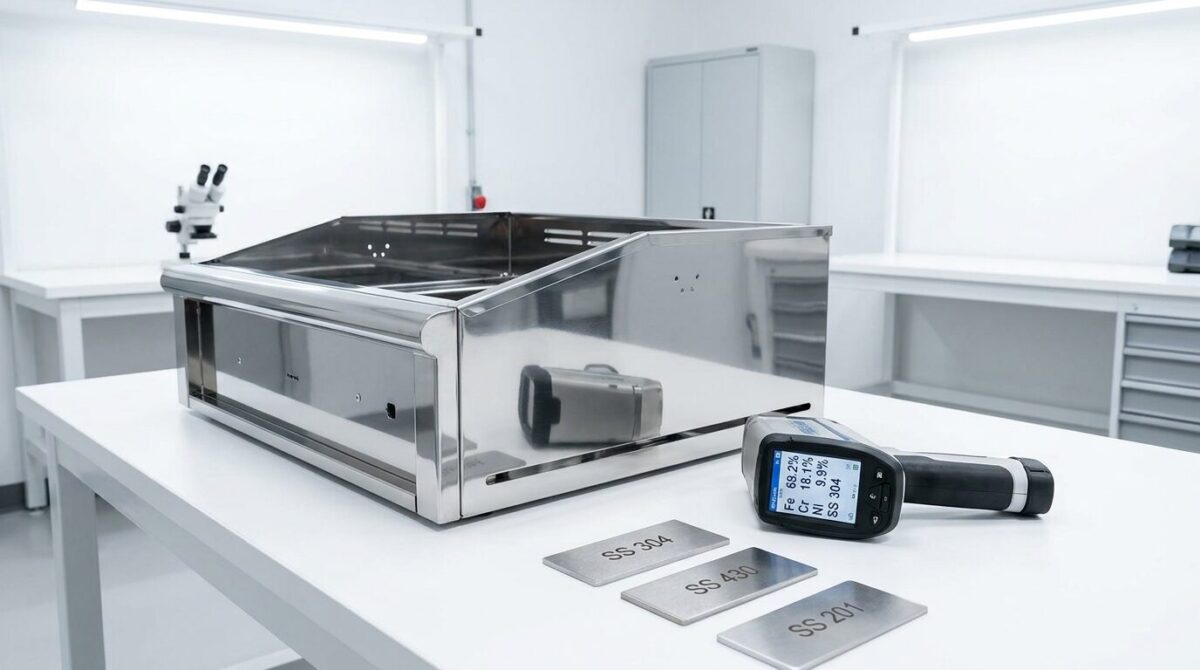
- In-house XRF Testing: Each shipment is tested to confirm the exact steel grade.
- Certified Documentation: We provide material certificates (MTR) for every export order.
Ready to discuss material specifications for your next order? Kontaktieren Sie unser Team to request mill test reports and a detailed quotation with your choice of 304 oder 430 stainless steel.
Liaoning Toshine Metal Technology Co., Ltd. specializes in custom BBQ grill manufacturing. We maintain full material traceability and help global brands select the right materials for their specific markets.